Hardware
One physical endpoint for unmodified computers.
StandardRL turns the ordinary interfaces of a host computer into a reinforcement-learning deployment boundary: display output becomes observation, USB HID becomes action, and the host does not need special instrumentation.
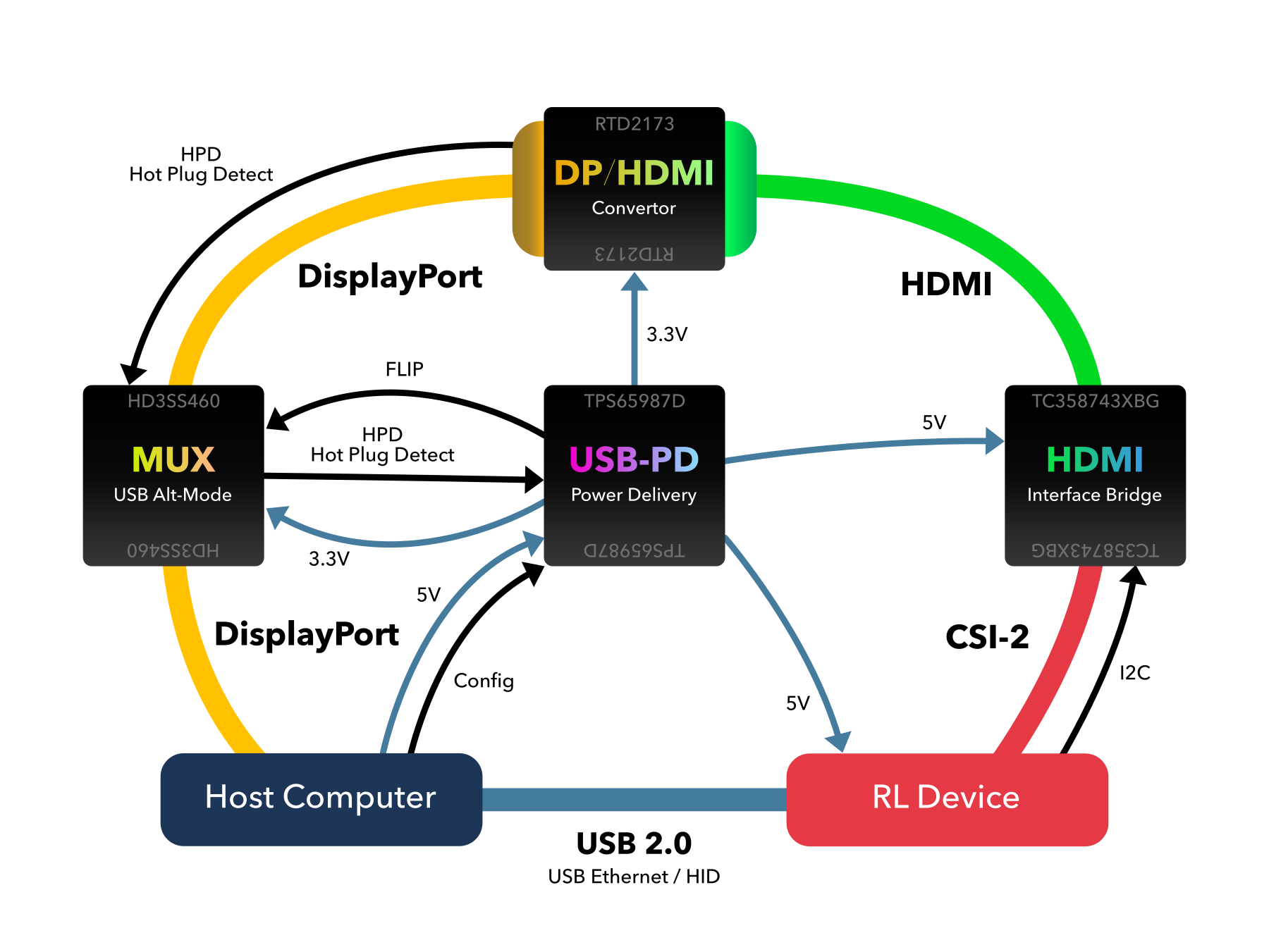
USB-C signal path
Power, vision, management, and action through one connector.
The current design replaces the earlier prototype's separate HDMI, USB, and power routes with a single USB-C architecture. A power-delivery controller negotiates DisplayPort Alt Mode and distributes power. DisplayPort video is routed into a capture path, while USB 2.0 remains available for Linux device mode, management networking, and HID emulation.
At a glance
- Host connection
- A single USB-C cable carrying DisplayPort Alt Mode, USB 2.0, and USB Power Delivery.
- Observation
- The host's display output, captured as rendered pixels — no host-side software required.
- Action
- Standard USB HID keyboard and mouse events, emitted through a Linux USB gadget interface.
- Compute
- Raspberry Pi Compute Module-class hardware running a Debian-based system.
- On-device model
- A compact MiniConv visual encoder, with heavier policy components served remotely over CALF.
- Status display
- A low-power e-ink face showing network, vision, and action state at a glance.
Signal separation
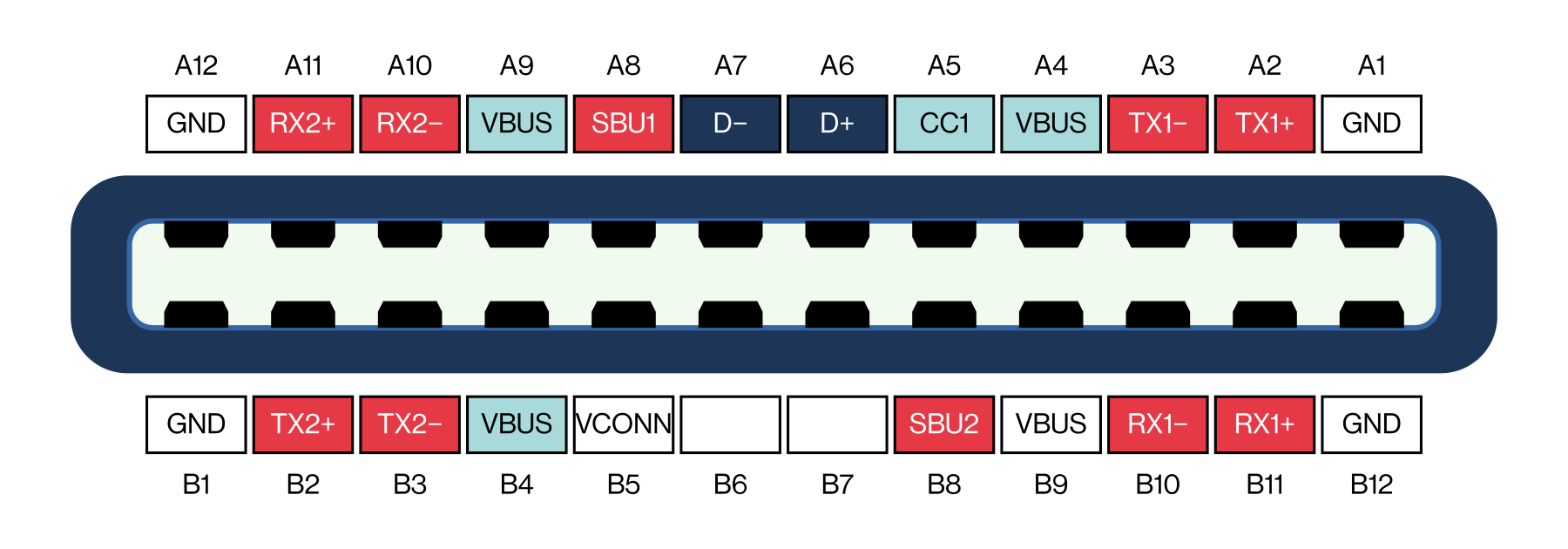
USB-C exposes distinct electrical paths. High-speed differential pairs can carry DisplayPort Alt Mode for the visual observation stream. USB 2.0 D+ and D- remain independent and connect to the Raspberry Pi in device mode. Configuration-channel and VBUS pins negotiate and distribute power.
Capture path
Once DisplayPort Alt Mode is established, the DisplayPort signal is routed through an Alt Mode multiplexer, translated to HDMI, and bridged into CSI-2 for capture by the Raspberry Pi. This gives the device a pixel stream corresponding to the host's ordinary display output.
That captured stream is the physical counterpart to the rendered-pixel observations used in the project's simulation environments, BrowserEnv and EnvCraft, where agents are trained against exactly this kind of screen-as-state interface.
Runtime path
The intended runtime loop is capture, local preprocessing, MiniConv visual encoding on the Raspberry Pi Compute Module platform, optional communication to a remote policy head over CALF, and HID action return through the USB gadget interface.
This is the hardware form of the split-policy idea: fast edge processing near the host, with heavier policy components able to run remotely when needed. The research page explains the split in full.
Operating system
The device software is based on Debian and standard Linux facilities wherever possible. The platform uses Raspberry Pi Compute Module-class hardware, with open-source components providing the base operating system, USB gadget behaviour, graphics support, networking, and web-based management surfaces. Management happens in a browser: point a host at the device and configure it directly, with no app to install.
A research hardware device should be inspectable, reproducible, and extensible by other laboratories — so the project intends to publish its drivers, packages, and integration code as they mature, alongside the open-source MiniConv and CALF components.
What is built, and what remains
Board-level integration, USB-C signal separation, the video capture flow, and HID and device-mode control have all been built and bench-tested. The remaining engineering is the complete task-level closed loop: coupling live capture to MiniConv, opening the CALF channel, and evaluating trained policies on concrete computer-interaction tasks.
StandardRL is a real hardware research prototype today — not yet a finished product or a fully evaluated autonomous-agent appliance.