Prototypes
Prototype development.
Development of the StandardRL device began in late 2023 as a larger testbench device based on the Raspberry Pi 4, known as Trent. A second prototype, Liverpool, followed as a smaller, lower-power design and became the basis of the current device, with later changes to the enclosure, display, cable, and internal hardware.
Prototype arm 01
Trent.
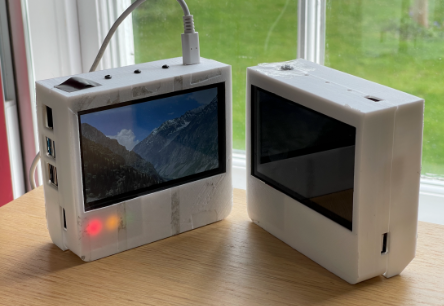
Trent was a testbench device, intended for development rather than portability. It ran a Debian-based system with a custom CALF client runtime, displayed live vision from the host, and could issue HID commands from a touchscreen, which was enough to run reinforcement-learning models that controlled a host computer.
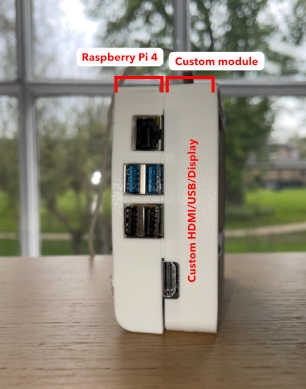
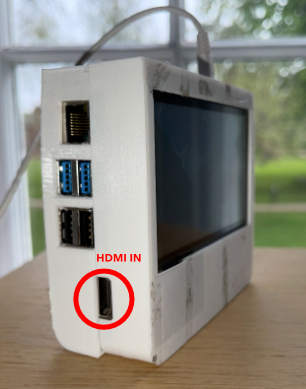
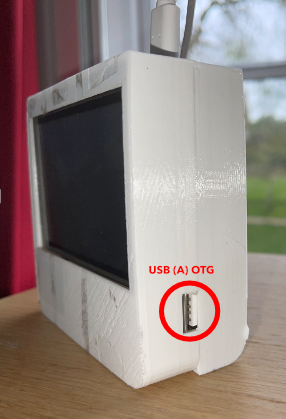
It was built as two mechanically connected modules: a Raspberry Pi 4 compute unit and a custom front module around a 4.5 inch IPS touch display, with three RGB status LEDs, HDMI input for vision on the left, and a USB OTG Type-A port on the right for HID. The two 3D-printed casings were screwed together as a sandwich, which kept the device easy to inspect and modify on the bench.
Prototype arm 02
Liverpool.
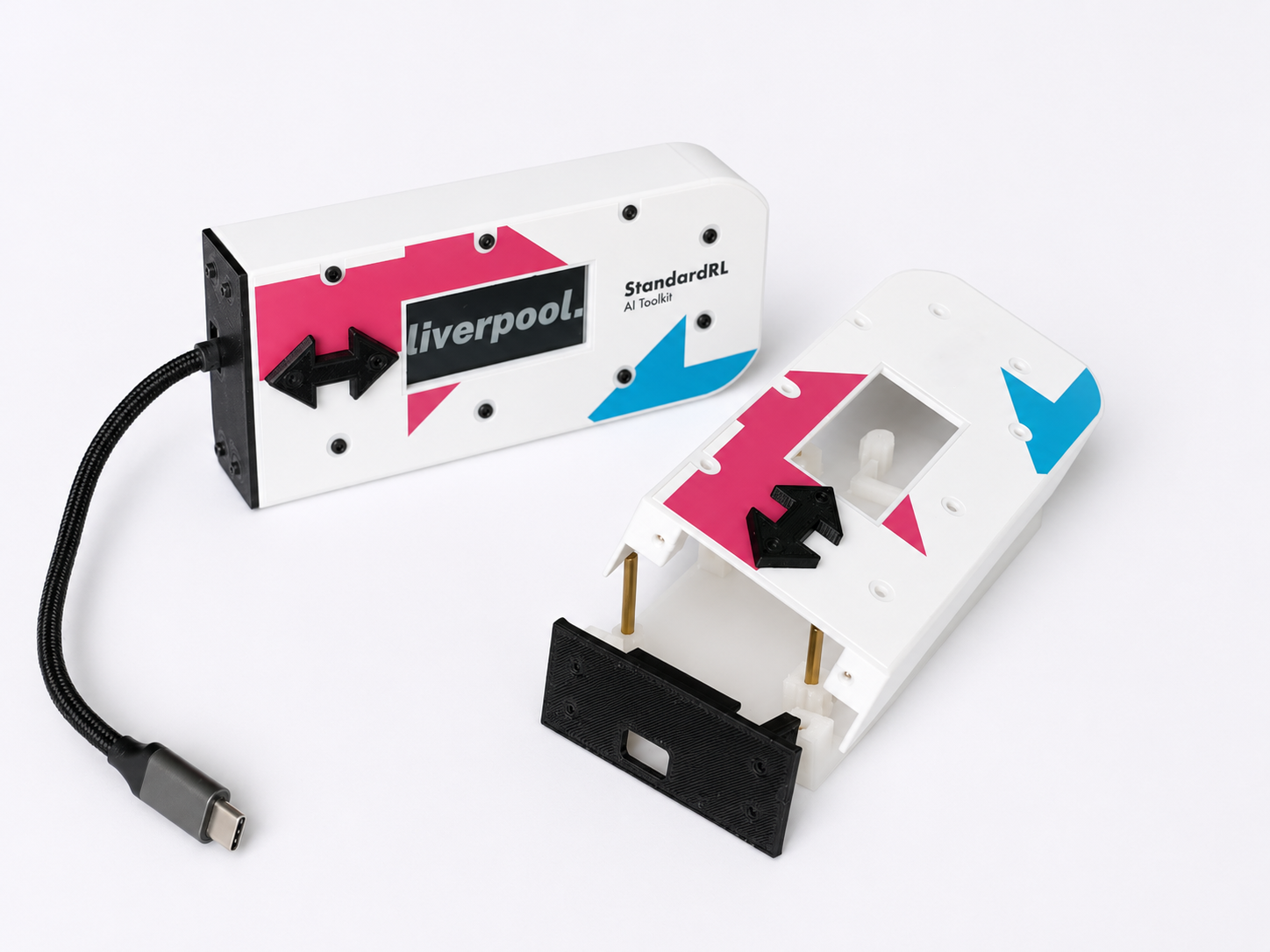
Liverpool was a smaller successor designed around a compact enclosure rather than a bench rig: a rear translucent panel for LED light, a solid plastic body, a printed top cover carrying the name and graphic design, a plastic StandardRL arrow logo, and a left-side entry that closes the device while letting the USB-C cable exit cleanly. It became the basis of the current design.
The first Liverpool devices used 3D-printed parts and compared internal compute options, including Raspberry Pi 4 Compute Module hardware and Raspberry Pi Zero 2 class hardware. The prototype therefore tested both the physical product direction and the compute trade-off at the centre of StandardRL: how much processing should remain on the device, and how much should be served remotely over the CALF stack.
Trent findings
Trent demonstrated the basic StandardRL proposition: a separate hardware endpoint could observe a computer, run local research software, communicate with CALF-style infrastructure, and act back through normal input channels. It was large, visible, inspectable, and well suited to bench testing.
Its touch interface was useful during development because researchers could view live input, inspect status, and manually issue HID commands without needing to attach a second control computer.
Transition to Liverpool
Trent was never intended to be the final product form. The two-module design was physically large, consumed more power than desirable, and needed a separate power supply input. It also used separate physical routes for vision and HID rather than turning the whole host relationship into one clean connector.
Those constraints directly motivated Liverpool: a smaller, lower-power prototype designed around a single USB-C approach for power, display capture, management, and HID-style control. Liverpool retained Trent's research purpose but changed the physical assumptions around it.
Display and enclosure
Trent used a bright IPS touch display because it was a development rig: it needed live feedback and direct manual control. Liverpool moved towards a smaller e-ink display, reflecting the shift from an interactive bench interface to a low-power identity and status display.
The housing changed in the same direction. Trent's two connected 3D printed modules made the system easy to inspect and modify. Liverpool instead explored a device-like enclosure with distinct casing parts, a printed cover, a rear light panel, and a controlled cable exit.
Compute trade-off
Liverpool was also used to compare compute options on low-power hardware. The experiments covered the same Raspberry Pi families that the MiniConv work evaluates (Pi 4B and Pi Zero 2 W), testing whether local visual encoding, compact communication, and remote policy execution could fit within a device of this size.
This addresses a central question for StandardRL: how much of the policy should run on the device, and how much should be served remotely.
Current position
Liverpool is the prototype line that led to the current device shown on the homepage. The current design keeps the Liverpool direction while refining the enclosure, screen treatment, USB-C cable entry, material choices, and internal arrangement.